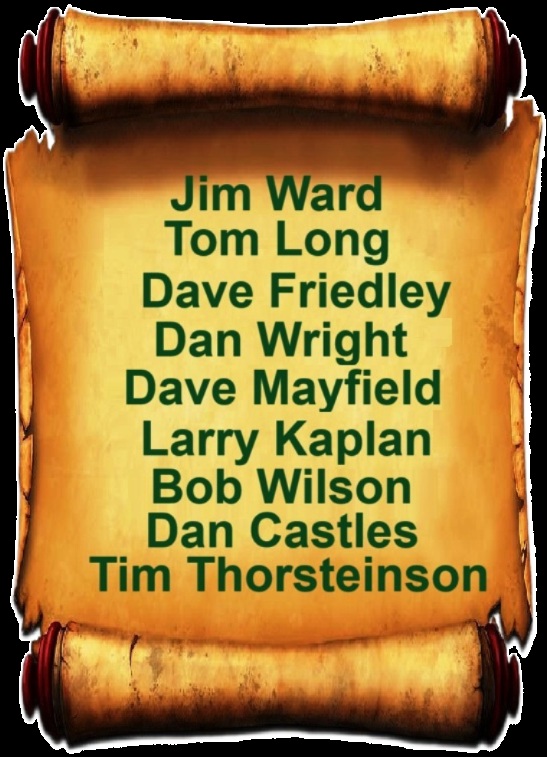
Tektronix owned the Grass Valley Company for almost 26 years and in that time, it saw 9 different "heads of state." Some held the title of General Manager, a couple ran it as Vice Presidents, and twice it was run remotely by someone with Tektronix up in Oregon. From the beginning of the Tektronix era there were at least two layers between the top person at the Group and Tektronix's office of the President.
Jim Ward was an accountant. He worked for a San Francisco firm that Dr. Hare hired to manage the company's books. Hare eventually hired Jim to serve as the company's CFO. When Hare left the company, he promoted Jim to head the company as Executive Vice President. But the president title was held by another, one who had been instrumental in buying the group.
By 1976, the group was a $10 million operation. It had 280 employees, 40 of whom were engineers. The payroll was approaching $3 million and was selling to 30 countries around the world. The Bitney Spring campus now had four buildings with 60,000 square feet of space. That year, the group sent 20 employees and $300K worth of gear to NAB, which was in Chicago that year.
Tom Long led the Communications Division at Tektronix, focusing on TV and video products. In that position, he also held the rank of Vice President. He, along with the Vice Presidents from the other three divisions, reported to the Group Vice President. The Group Vice President reported to Tektronix's Office of the President, which included the CEO and COO. Long oversaw Grass Valley. Tom Long was protective of the group. He tried to limit Tektronix's meddling in daily operations. Also, he never directly ran GVG.
Ward and Long did not hit it off. Ward refused to provide Long with detailed operational information he wanted regarding the Group.
Ward used cash accounting. This means he recorded payment receipts when they were received. Expenses were noted when they were actually paid. Revenues and expenses were noted when cash came in and went out, respectively. Which was out of step with what Tektronix did. Ward wouldn't standardize Profit and Loss statements. Instead, he checked how much money was on hand at the end of the year. If it was more than at the start of the year, it was assumed that the company made a profit. Long wanted Grass Valley to operate independently from Tektronix. However, he still had to report financials to his bosses. Ward's push to follow Hare's rules clashed with Tektronix's approach. Long made a change in 1978.
In the fall of 1978, Jim Ward called an unexpected "managers meeting." During this meeting, he announced that Dave Friedley would take his place. The attendees were stunned by the news. No one had ever heard of Dave Friedley before, much less met him. And no one knew that Tek had plans to replace Ward. Given the circumstances, he was very gracious and professional. He indicated that Tek had offered him the opportunity to stay on as CFO, but he declined their offer. He said that he felt it would be better to move on. He later joined former GVG members Merv Graham and Mike Patten at their company, Graham‐Patten Systems.
Dave Friedley was sent down from Tektronix. This move cemented the integration of Tektronix's control over the group. Friedley had been the Marketing Manager of Tek's Frequency Domain Instrumentation. That is, Spectrum Analyzers and the like. It took only four years for the last person (there is one brief exception) to have run the group, who had started at Grass Valley, and not somewhere else, to depart.
During his time as head of GVG, Dave Friedley aimed to change the culture. He aimed for it to align with Tektronix's vision. It should be more structured and less freewheeling than in the past.
Friedley graduated in electrical engineering from Cornell University. He joined Tektronix in 1974. Before that, he worked in sales engineering and marketing at Gen Rad, formerly known as General Radio Company. At Tektronix, he became the marketing manager for spectrum analyzers. In the next four years, he managed frequency domain instruments. Then, he was chosen to be the Group's General Manager.
Friedley spent the first year holed up in his office, and then finally came out and got acquainted. Over time, he had a polarizing influence. Some saw him as one of the group's best leaders, while others viewed him as one of the worst.
One of the first things Friedley did was bring down Greg Fenner as the group's CFO. Fenner played football for Purdue. Some who didn't like him said he had taken one too many head butts. It was also claimed that he got the job because he was in Big Brothers Big Sisters in Beaverton. He had helped Tom Long's son overcome drug issues.
People knew Friedley had a temper, and some claimed he liked to pit one group against another. A Grass Valley engineer recalls having dinner with Friedley in New York City. Friedley ordered lamb chops. The waiter brought the dinners, and his dinner companion said, "Hey, they didn't bring you any mint jelly." Friedley laid into the waiter and the chef for serving lamb without mint jelly.
After finishing Building Seven at the Bitney Springs campus, Friedley moved in. His area had nice carpet, but the engineering areas were just bare concrete. He was asked why this was the case at an all‐hands meeting. He responded because "Engineers are 'not the cleanest' People." Kind of tone‐deaf, many thought, which went over like a lead balloon. One person acted on it. The next weekend, someone brought in thousands of fleas and placed them on the carpet.
There's some disagreement among Friedley, Mike Patton, and Merv Graham about Patton and Graham not being able to get the 300 video switcher to the 1979 NAB. This was a third‐generation switcher project from ABC. It broke new ground. Much of the engineering to meet the targeted external specs had not been developed yet. In fact, much of the basic strategy and approach was still unknown. In the end, the pair went off to start their own company, aptly called Graham‐Patton. That company was soon joined by Jim Ward, as we mentioned earlier.
But as General Manager, he did a lot of good. Friedley oversaw the introduction of EMEM, spearheaded by Bruce Rayner. He also funded Birney Dayton's development of hybrids, both of which we will cover in future articles.
In 1979, the Group brought in $287M in sales. The next year that had been raised to $352M. He promoted Len Dole to International Sales Manager. Dole was hired in '77. Up until that time, sales were being handled by Tektronix's sales force. They did not know how to sell the Group's flagship product, video production switchers. Dole laid down the law about not using Tektronix and won. He did the same thing with Sony in Japan, which was selling GVG products into Asia and Europe. He also demanded that the Group make more products for the PAL television standard. PAL was the analog color standard for much of Europe and South America. They shouldn't just focus on products for the American NTSC standard.
Under Friedley's and Dole's direction, by the end of 1981, the Group had over 20 sales staff in the States. About a dozen were in the field. In November, the Group held its first European dealer training. This step aimed to reduce the company's reliance on a potential future competitor. Up until then, Sony handled most of GV's sales internationally.
In early 1982, the Group set up a five‐person service and support team in Winchester, England. In August, the Group picked 25 U.S. distributors. They would help sell products in the non‐broadcast market.
As mentioned, Friedley made sure Dayton's hybrid project received funding. Then, in 1982, he promoted Dayton to Director of Research and Engineering. That year, he created a $117K grant for Sierra College. This grant was to help train electronic techs and assemblers over the next two years.
A couple of years after Tektronix bought the Group, Tek changed its structure. Up until then, it was organized around specific product lines. Now it would be divided into divisions based on large general markets. The company had centralized manufacturing, R&D, and marketing and sales. It also had a HQ corporate staff. Four product divisions were formed. The Instruments Division looked after the legacy products, mainly scopes. The Design Automation Division covered microprocessor development, semiconductor testing, and logic analyzers. The Information Display Division focused on displays and terminals. It also included the company's new printer products. The Communications Division covered cable testers, spectrum analyzers, and anything related to television. That included the Grass Valley Group. The president of the Group reported to Tom Long, who was the VP and GM of the Communications Division at the time.
Friedley was charged with testing a case for the Group's "divisionalization." This involved splitting the Group, similar to what Tektronix had done. The chaos around the 300 switcher launch made the experiment feel more important. We will discuss the 300 saga in an upcoming article. In late 1980, Friedley picked modular products. This included equipment like DAs and other processing gear. This choice made sense. Modular produced enough product and followed the classic production line model. Routers and production switchers were like job shops. They were unique, custom products.
Friedley chose to completely separate this division. He placed the new Modular Division at the airport. Up until then, all parts of the company used common engineering, production, and testing. Modular became a totally separate and stand‐alone operation.
Dan Wright worked as a manufacturing engineer for Tektronix up in Oregon. He was in the spectrum analyzer product line within the Communications Division. The same department that Friedley had come out of. This division also included the Grass Valley Group. In 1979, Friedley brought Wright down to the Group. Wright was to help get the 300 switcher into production. Wright was an accomplished technocrat. But he was now up against what the group's engineering had been struggling with. They still weren't sure what to build to meet the 300's advertised specs. The final design of the 300 was a moving target until the end of 1981. Wright was successful in helping to iron out how to build the 300. When Friedley decided to "divisionalize" Modular, he named Wright as the general manager of that first division.
The Modular Division had a marketing team led by Randy Hood, who later became G.M. It also had its own manufacturing, managed by another rising star, Dave Mayfield.
Randy had no experience in television and only a little in electronics. Before joining the group, he played AAA baseball. Dan Wright liked him for his hustle. So, one of Jim Michener's tasks was to mentor Randy. The photo was a playful example of how sound travels over a fiber optic cable. Hence the string and two cans. As we will see elsewhere, fiber products were a part of the GVG story.
To promote WaveLink, the groups fiber product, before it became its own department, Randy and Jim went on a nine‐city tour. They introduced Randy to GV's field sales force and some customers. They gave talks and demos of WaveLink at different Society of Broadcast Engineers (SBE) meetings during the tour. After about three of these, Jim felt like it was Groundhog Day. Randy wanted to see the major league baseball parks. Included in the tour were Atlanta, Cincinnati, Detroit, Kansas City, and Washington.
Before they left, they did a dress rehearsal at an SBE meeting at nearby KCRA in Sacramento. Others from the group attended, and they polished the presentation. Afterwards, there was a young lad who asked many questions. Jim eventually asked him what he did at KCRA. An intern in the news department was his answer. When asked why he'd attend a "boring" SBE meeting, he said he wanted to see what happens behind the camera. Jim agreed that it was a good thing. Jim then asked him what he wanted to do after school, and he said, "I want to anchor the NBC Nightly News." KCRA was an NBC affiliate. "Okay," Jim said, "by the way, what is your name?" "Lester Holt," he replied.
The group still ran a central manufacturing operation for other products. This was led by company veteran Jerry Sakai, who was the VP of Manufacturing. Sakai's group stayed centralized. The machine shop, PCB fab, materials planning, purchasing, and warehousing provided services to other divisions. Sakai's group was meant to act as an outsourcing entity for the divisions. So, it had to stay competitive with outside sources.
In June 1981, two new divisions were created: the Production Systems Division (PSD) and the Broadcast Systems Division (BSD). PSD was switchers and associated products. PSD was the 800‐pound gorilla, making up 60% of the Group's sales. It had over 400 employees, with 200 to 250 working in assembly.
The move made sense because PSD customers are creative. They often want more features and capabilities. Chuck Clarke, the division's Marketing Manager, said, "It's like fashion. You have to be in style." This contrasts with the MSD and BSD divisions, which dealt with more technical types than PSD did.
Leon Stanger, who took over the 300 debacle, became a Project Manager in PSD and reported to Ralph Barclay. BSD eventually became the Switching Products Division. They mainly made routers. Jay Kuca, who eventually would head up the company's marketing effort was BSD's Product Marketing Manager of Routers. Jay went on to hold key marketing positions at other prominent companies in the area, as we will see in another article.
Wright believed in separate product divisions. Before Tektronix split into divisions with their own engineering teams, he felt the centralized engineering was too controlling. In 1983, Friedley left the Group for a promotion to VP of Tektronix's Communications Division. He then promoted Wright to take over as President of the Group. In that capacity, Dan continued Friedley's efforts to "Tekify" the Group. He would eventually follow Friedley and run the Communications Division, too.
Not everyone thought divisions made sense for the Group. The Group still had some common resources such as sales, PC fab, and metalwork. It would have been cost prohibitive to set up PC fab and machine shops for each division. Plus, the sales team must enter a customer's facility, mostly broadcasters back then, and sell everything the company offers. The Group only had one case where their customer base wasn't broadcasters. That was Wavelink, which mainly sold to Telcos.
Another issue was an accounting one. The company faced transfer pricing issues. This is how one division pays another, which helps keep its finances separate.
One person who thought that the concept was taken too far was Birney Dayton. He ran the hybrid manufacturing operation until 1985. Then, Wright chose to expand that across all divisions. One factor is that Wright believed Birney wanted to run his own business or division. Birney still held the title of V.P. of Engineering. However, most engineering tasks were now shared among the divisions. Wright kicked Dayton out of hybrids during "divisionalization." He then put him in charge of Wavelink.
Most divisions struggled with hybrids. Hybrid manufacturing was the Group's most complex task. It was halfway between PCB and IC manufacturing. Dayton believes Modular was the only division that managed it well. This success came from Jerry Sakai's dedication and expertise in managing the implementation.
Sakai, as V.P. of manufacturing, oversaw the Modular Division. He served as Administrative Manager through the management council set up by Friedley. Bill Rorden was the Administrative Manager of BSD, while Bob Cobler held the same role at PSD. It is interesting to note that Sakai and Rorden were engineers, while Cobler was in marketing. It would lend credence to what Chuck Clarke said a few paragraphs ago.
When the Group was completely split up into divisions it was organized as follows: 1) Modular Products Division (MPG) - This division made all the modular "glue" products 2) Production Systems Division (PSD) - which eventually became the Professional Video Division. They made switchers. Next to Modular this group was the closest to a regular assembly line operation, as the smaller production switchers were far more off‐the‐shelf products than high end switchers and routers. While the high‐end switchers were much more of a job‐shop operation making highly customized, expensive products. It accounted for 60% of the sales, the other two had about 20% each. This division had at its formation 400+ employees, over 200 in manufacturing alone, out of a total of 925 total employees at the time. 3) Broadcast Systems Division (BSD) - which eventually became the Switching Products Division. This group made routers, automation, and ancillary products like 10 by 1 small switchers. 4) Wavelink - which was a part of MPD
Actually, Grass Valley's divisions were "hybrids." Divisions make sense if there are no common resources such as sales, PC fab, or metalwork. With Grass Valley, this was not the case. Wavelink was the only part of the company with its own sales team. It served a different clientele. The divisions did have their own engineering, manufacturing, and testing. But the service force was still one group under Corporate Marketing.
After building 9 was completed in 1982, it was occupied by PSD, along with the machine shop and PCB fab. The company's PCB fab operation was an asset into the 80s as Tektronix was also paying to use it. In '82, it gave the Group an order for 3,200 PCBs for a new product they were producing.
Now that the company split into divisions, the management structure at the Group became more complex. In 1982, the hierarchy was the three divisions. MPD's Division Manager was Dan Wright, BSD had Denny Ebner as its GM, and PSD had Jim Tetzlaff. There also was a Corporate group that was comprised of accounting and legal. Under the hybrid "divisionalization" model, VPs still managed key areas. Jerry Sakai led Manufacturing, Bill Rorden handled Engineering, and Bill Cobler oversaw Marketing.
Those three positions were part of a "management council." Also on that council was Greg Fenner, VP of Finance and Planning. Dave Friedley, the Executive VP, led the council. He was the highest‐ranking officer at the Group. Each Division's GM had an Administrative Manager and a VP on the management council. Sakai was over Wright, Rorden over Ebner, and Cobler over Terzlaff.
There were a couple of exceptions. The hybrid team when it was led by Birney Dayton, the Corporate Component Development Manager reported to Rorden. The other was the Tech Arts and Publications, who also reported to Sakai. Also, Facilities Manager Ken Myers reported directly to Friedley.
But problems were starting to gather and grow. The catalyst was what the company had thrived on up until then. Up until then the Grass Valley Company thrived on giving customers what they wanted. If the company could make a profit by taking a customer's request and producing a product, it would often do that. As we have stated in previous articles, a lot of the direction Grass Valley followed was from ABC. Early on, this guidance was usually a good thing.
For many years, even after Doc Hare, the Group led the TV industry. Movers and shakers traveled to Grass Valley to see what the company offered and find solutions to their tech problems. At some point, that spirit of being out front and leading the way gave way to a more cautious and buttoned‐down way of doing business. Many would argue that that was Tek's doing, and in many ways it was. Some of this could be that the company outgrew the small‐town mindset of Grass Valley and Nevada City. Its roots were clearly local. At one time, the Sierra foothills served as a draw for recruits. But times and attitudes inevitably change, and that change was already happening.
There was a player out there who usually didn't follow markets; they made them. It is one thing to have your antenna tuned to what people are saying they want. It's quite another to envision where the market will be in 10 years. And act accordingly. Before most others even know what path will be followed. The Group continued to concentrate on where they were, and not on where they needed to be headed. As we will remind you further along in the story, this worked until it didn't!
In April 1983, Tom Long left Tektronix. He headed east to Analogic in Peabody, Massachusetts. There, he served as Executive VP for Operational Management. Long, was the President of the Group for nine years. At the time GVG's Management Council said, "Tom's expertise and leadership during his 23 years at Tek have been a great asset to our company. We will miss him and wish him well in his new venture."
Long didn't fit well in his new role and location. The next year, he returned as the VP and GM of Tektronix's Design Automation Group. He also became President of the Tektronix Development Company, where he managed Tektronix Labs in Beaverton.
While he was only gone from the company for a year, it left an opening for Dave Friedley to move up. Tektronix EVP Bill Walker said, "Dave's experience with both the Communications Division and the Grass Valley Group makes him well suited for his new responsibilities. The Communications Division and the Grass Valley Group have, over the years, maintained their leadership positions in their respective markets. Dave's expertise and leadership will greatly contribute to the Division's continuing record of success." Friedley, his wife Carol, and their three children relocated to Oregon.
For the first and only time, a leader from the Group began climbing the Tek corporate ladder, rather than being "sent down" to manage it. This demonstrated that, at the time, Tek was happy with Grass Valley's contribution to the larger organization.
Before Dave left for Tektronix, he made Dan Wright Executive VP. Wright promoted David Mayfield to Modular Product Division's GM as his replacement. Wright was a manufacturing engineer. He played a key role in getting the 300 into production. Under Wright, the commitment to "divisionalization" continued. Some believed this focus led to silos and competition within the company. This, they felt, hurt employee morale. It was also claimed that he tried a few McKinsey and Tom Peters‐type strategies. One such strategy was management by walking around (MBWA). That method seemed effective. Wright was known for visiting and doing tasks alongside the employees.
Most thought Wright was a nice guy but even practicing MBWA he never quite understood how people worked. He was not a pure technologist, so at times he did not understand the technical ramifications put before him.
The "divisionalize" idea had some merit. At that time, the Bitney Springs site started to show limited growth potential. Nature and local government were making it hard to sustain the site. That left a couple of choices. They could start by moving Modular Products manufacturing to leased space. Then, it would still report to Jerry Sakai and fit into the Bitney Springs hierarchy. In 1982, the company decided to buy a second site, the Providence Mine. This choice would have spread out its operations anyway. At the time, no one had an inkling that eventually that dispersal would be worldwide.
Dan Wright grew up in Monticello, Indiana. He graduated from Purdue University in 1968 with a degree in engineering technology. He went to work for Collins Radio in Cedar Rapids, Iowa, before joining the Air Force during the Vietnam War. Five years later, he left as a captain. He had a lot of experience running evaluation missions for the Aerospace Defense Command.
He joined Tektronix in 1974 as a design engineer. Five years later, he was a manufacturing manager when he signed on at GVG. In 1980, he became the manager of MPG.
It was said that Friedley was Dan Wright's rabbi. That is meant without any religious or spiritual significance. But as "a primary sponsor or protector" or "mentor or teacher." Both were true in Friedley's case.
In 1984, the 1680 production switcher was introduced. It had a familiar layout for 1600 users but included many features from the 300 model. Also, the highly successful 100 small production switcher debuted. That year, Wright oversaw the Group's acquisition of Dubner Computer Systems. This allowed Dan to check the box "did an acquisition." ABC, still the Group's biggest customer, liked Dubner products. This made it easy to sell to Tektronix and the Group's customers. Julius Barnathan, ABC's head of engineering, played a key role in the deal. He had a big investment in Dubner equipment. He wasn't sure that Harvey Dubner, the founder and CEO, could run the company well. In the end, the Dubner acquisition didn't succeed. Wright and his team didn't know how to manage Harvey. The brand was retired by the Group in 1991.
In 1984, the 25th anniversary of the Group, there was some bait concocted to lure Doc Hare to come to NAB. Bill Rorden flew him there in his plane. The event honored Doc, and ABC was the presenter. The players, from left to right, are: Dave Friedley, Helen McMillen, Bob Cobler, Julius Barnathan (VP ABC Engineering), Jerry Sakai, Doc Hare, Birney Dayton, Hazel Hare, Vern Pointer (Executive VP, ABC), Max Berry (one of ABC's top engineers), Dan Wright, Bill Rorden, Bob Johnson
1985 brought a few new milestones. A new audio/video router, the Horizon, and a new line of modular products, the 8500, were introduced.
Wright also did another acquisition, Interactive Systems Company (ISC). Dave Bargen started his company because big post companies on the U.S. West Coast wanted to improve their CMX editing suites. They didn't want to wait for Bill Orr's company to release an updated CMX editor. CMX was a joint venture started by CBS (the C) and Memorex (the MX) to build what became the first sophisticated videotape editing system. These systems were big, not small. They were also expensive. A complete system could cost between $60,000 and $200,000. They featured a DEC PDP‐11 mini‐computer along with Intelligent Interfaces, known as I‐Squares. Each device required its own I‐Square for control. In the 80s, memory was costly. Microprocessors weren't advanced enough yet. So, instead of today's desktop editing, you needed a whole room full of gear. The post houses asked Bargen to develop new software. This software added extra features to the current CMX hardware.
The software came to be known as 409, as it claimed to clean up the "bugs" in CMX's software.
Bargen knew ISC needed to control video and audio peripherals for long‐term success. He needed his own version of the I‐Square. Bargen's longtime friend, Jack Callaway, was the chief engineer at Vidtronics. He had deep expertise in VTR machine control. Callaway and Bill Gordon reverse‐engineered the CMX interface protocol. They created a simpler, smaller interface. Where the CMX I‐Square was about 12 inches high, Callaway's was less than two inches tall.
The units became known as Callaway boxes and allowed ISC to offer editors an alternative. Complete ISC systems sold for $30,000 to $50,000. This system spelled the start of the end for CMX. CMX could have made a smaller I‐Square. But, they felt their system needed to keep a larger box, as it presented a way to charge over $10K for the I‐Square.
The other nail in CMX's coffin was the introduction of the RS‐422 remote control standard. As we will see later, RS‐422 greatly helped NVISION. In their quest for relevance, they started producing RS‐422 routers. But RS‐422 undermined the business model that CMX had thrived on up until that time. Before that, each I‐Squared needed different hardware setups. This was based on the specific device being controlled. Thus, an I‐Squared configured for one device could not be used with a different device. RS‐422 was first introduced in 1975. By the mid‐80s, it began to be widely used in devices. RS‐422 simplified connecting I‐Squares to various devices. This often ment that a facility needed fewer of them. After CMX and others switched to RS‐422 control, the interface hardware stayed the same. Only the firmware changed. With ISC the Group was now squarely in the editing market.
That year also saw an infamous meeting with Sony at NAB. Sony wanted the Group to productize and offer an analog HDTV version of the 300. Wright wanted to see a market first.
Before that time, the Group usually responded to customer requests, often from ABC, before moving forward with a product. Sony was different. They held a stronger place in the television market, both for consumers and broadcasters, than the Group did. Color TV sales were leveling off as market saturation approached. Sony sought ways to encourage more purchases. As RCA had ordered NBC to make all shows in color at the start of the 60s to boost color TV sales, Sony now aimed to create a new TV market for its products. They were taking the long view. The Group could not or would not do the same. ABC may be partly to blame for not addressing the rise of higher video quality technology, like HD, sooner. ABC, as mentioned, viewed Grass Valley as their equipment development arm. If ABC wanted something new, that seemed to the group that there was a need validation. ABC had no interest in HD at that time. Also, the Group's limited resources were focused on their first Digital Video Effects engine, the Kaleidoscope. It was an ambitious project for the company. We'll delve into that in an upcoming article.
In late 1987, construction began at the Providence Mine site on the first three buildings. When it was bought at the end of 1982, the plan was to support growth. Many believed this growth would continue in the area. The thinking at the time was that the company's growth rate would continue at 15%. As already mentioned the Bitney Springs site was quickly nearing full capacity, and its environmental costs were rising.
The new site was planned to hold 2,000 employees in a dozen buildings. Being just 500 feet from a main water line and next to Nevada City's wastewater plant made it appealing. It also had easy freeway access while feeling secluded. This combination seemed like a smart move. As we will see, there was another reason for the new campus. Bitney Springs was becoming untenable due to the threat of fire.
In 1987, Friedley made it to the top of Tektronix. He replaced longtime president Earl Wantland. The company sought someone to tackle the growing issues in a new way. Friedley had started at Tek and was sent down to the Group as its first Tek‐minted manager, the company in the 80s had done well. The company was "on top of its game." As mentioned earlier, he replaced Tom Long in '82 when Long left as the head of the Television Division at Tek. From his Tek vantage point, as head of the TV division, Friedley and Wright had shepherded the Grass Valley operation with steady growth. The Production Systems Division (high‐end switchers and DVEs) and the Professional Video Division (low‐end switchers and DVEs) both experienced strong growth during that time. But all the company's divisions saw decent growth during the period. Those were the heady days of the Group. When it was time to replace Wantland, the division manager for Grass Valley was the obvious choice. Grass Valley brought in half of the Television Division's revenue at that time.
At the same time Friedley replaced Wantland, he could not have ascended to head Tektronix at a worse time. Tektronix had acquired CAE Systems Inc., a computer‐aided engineering firm. They then launched their first Computer Aided Design (CAD) workstation. It was short‐lived. Four months later, the company announced a change. Instead of making workstations, it would now develop software for other manufacturers. That too faltered. So, one of the first things Friedley did was sell its CAE operations at a fire sale for $5 million to Mentor Graphics. Estimates of Tek's losses from this ranged from $150 million to $225 million.
When Friedley became Tek's CEO, he replaced three of the four top Tek Vice Presidents. Wright led the Group until 1988. Then, Friedley used him as his replacement once again. Wright became the VP of Tek's new Communications Division. This division came from the TV Products Group. It included the Group, Tek's Video Products, Network Analyzers, and Tek's Hybrid Circuits. Wright tried to do this job from Grass Valley and not move back to Oregon.
Along with Wright, Friedley also named Larry Kaplan, head of the TV Products Group, as the VP of the new Information Display Group. This group had workstations, terminals, printers, and printed circuit board operations. Kaplan would take a more prominent role, as we will see.
Despite annual revenues that had almost doubled in ten years to $1.4 billion in 1985, they had stayed there since. Tektronix reported its first‐ever loss of $16.7 million for fiscal 1988. Friedley later told Forbes, "The first thing we did was stop the bleeding." Friedley also cut 2,500 jobs at Tektronix over the next two years. He focused on leaving unprofitable businesses. Business Week reported that Friedley "cut through bureaucracy like a logger through the nearby Oregon timber." Tektronix became modestly profitable in 1989. This was thanks to strict cost‐cutting and a new range of color printers. But its financial troubles were far from over.
1988 was a bad year for the Group also. On September 11th, what was known as the 49er fire started. It burned through part of the Bitney Springs site. Luckily, it only took a couple of ancillary buildings. Tek suddenly realized they had a company making $129 million a year in a spot that could easily burn during California's long dry season each summer and fall.
A positive development was the Kadenza. It transformed the Kscope DVE into a complete standalone switcher, and it had begun shipping.
During the 80s, the Group, from a growth standpoint, had a very good run. At the start of the 80s, the Group was below $50 million a year in revenue; by '89 it had grown steadily to $158 million. At the start of the 90s, that growth hit a wall.
Dan Wright named Dave Mayfield as his successor. Mayfield's title was Executive Vice President and GM of the Group. Mayfield had been the division manager of the Professional Video Division (PVD). This division had formed a couple of years earlier and was the small switcher division at that time. Many were surprised by his appointment. Mayfield had no experience managing multi‐functional groups at all. Some said his only "qualification" for the top job at GVG was his close friendship with Dan Wright, and that they both attended the same church.
During Mayfield's time, the company launched a new switcher line called the Diamond. This was an analog switcher. They also introduced a new DVE, the DPM‐100.
The company was still considered novel and eccentric, but in interesting ways. Grass Valley Group sat roughly 150 miles northeast of San Francisco. They owned an airplane to transport customers to their secluded, forested headquarters. Some saw the Group's remote outpost as both a plus and a minus for recruitment, according to Mayfield.
An article by the LA Times at the time stated: "Designed to appeal to 'free‐thinking' employees (one company executive ventured to call them 'mavericks'), flex‐time schedules are available for most of the nearly 1,000 workers who work in Grass Valley. Assemblers work in self‐managed 'cells' rather than production lines, rotating jobs and setting their own production goals. As an added incentive, a profit‐sharing program was introduced in 1976."
The article continued: "A fitness trail winds its way through the 330 acres of campus‐like grounds, and fleets of bright turquoise company bicycles are parked outside each of nine buildings to carry employees and visitors about the grounds. And if the habits of the free‐thinkers at Grass Valley Group sometimes border on the eccentric, so much the better. One department is so adamantly unorthodox that if an outside salesman makes a call wearing a necktie, he'll more than likely lose it to a pair of scissors, according to Bob Johnson."
The start of the 20th century's last decade was going to be a tumultuous time for both the Group and its mother ship. In early 1990, the company faced losses. Tektronix stock dropped from $31 a share in 1987 to a 14‐year low of $12.75 a share. In 1990, Tek posted a loss of $25 million, and sales were down 3%. Tek's main competitor in the test equipment realm was HP. In 1980, Tek was 1/2 the size of HP; by 1990, Tek was only 1/8 the size. A financial analyst for Prudential‐Bache Securities, Inc., told Business Week that meetings with Tektronix "were like watching the grass grow." The anticipated shake‐up came in March of 1990, with the company headed toward a $92.5 million loss (largely due to restructuring) for the fiscal year. Robert Lundeen, a former Dow Chemical Co. executive and Tektronix's chairman of the board, and William Walker, another board member, ousted Friedley and took over operational control of the company. Even though 62% of Tek's products had been introduced since 1986, they told Friedley that the turn'around just wasn't happening fast enough.
The printing division showed many signs of progress. It was growing quickly, reaching $90 million in sales. New graphic terminals which had previously taken three years from conception to production, were taking only nine months. A speedup in the design process was one of Friedley's goals. Tek faced another challenge: a slowdown in the economy. Its biggest customers; defense, computer, and semiconductor companies, were all trying to cut costs.
Tek's latest workstations had software issues. Also, problems at Tek's semiconductor fab lines delayed the shipment of test equipment. The company had captured only 3% of the workstation market. Its future for growth looked bleak. Friedley found that many engineers in the company didn't pay enough attention to the end customer's needs. He was quoted as saying, "I'm sure some of our whiz‐bang people wouldn't know a customer if they saw one." The issue wasn't that the company wasn't investing in the future. It spent $190 million on research and development in 1989. The problem was many felt that the company wasn't getting a decent 'bang for the buck' from the money spent.
HP's Dean O. Morton, the CEO of their main competitor, noted that they lacked a clear strategic vision. He said, "They've had a difficult time figuring out what they want to be." Ironically, a decade later, HP faced a similar issue. They spun off all their legacy product lines into Agilent Technologies and kept only printers and computers. In 1990, Tek had a similar product mix. Printers were doing well. Test equipment and semiconductors showed mixed results. Television product lines, however, were becoming more burdensome. The company's major investors had become impatient. At that time, a couple of major investors said they believed the company was worth more if it was split up than as a whole.
Lundeen explained to Portland's Business Journal that they needed to act fast. He said, "I don't think management realized how urgent it was that we get there quickly." Lundeen told Forbes, "I'd like the new Tektronix style to be more cosmopolitan," and he complained, "We're still doing things the Beaverton way." Lundeen initiated another 1,300 layoffs. Tektronix faced a setback to its image when it moved over 1,200 workers from Vancouver, Washington, to Oregon. This left a 488,000 square foot manufacturing facility empty in Jack Murdock Park, named after the company's co‐founder. For years, Tektronix had been the largest employer in Oregon, with a high of more than 24,000 employees in 1981. But by the end of 1991, the company had a workforce that was less than half that.
Birney Dayton said Mayfield's promotion was the last straw. It pushed him to leave and start NVISION. With Mayfield, the company's status quo, which was already fraying, seemed to change. Before Dayton left, Tektronix bought a company in the Bay Area. It was called LP Communications, and they made a T1 tester. Birney and a few others, along with the LP heads, convinced Wright to merge it with Wavelink. Now, they would have had one standalone business. This would make it worthwhile to develop and market. Wright finally decided not just to spin off this group but that all Tektronix should be spun off the same way.
Wright pitched the Wavelink spinoff to Friedley. Friedley didn't like Dan's proposal. The idea was that the parts were worth more than the whole. Friedley thought this approach would drive short‐term profits. It aimed to maximize returns when selling the company in pieces. But in the long term, it would hurt the overall health of the company.
Wright had pondered at times if it would be better if Grass Valley and Tek divorced. Others began pushing for the leveraged buyback of Grass Valley from Tek. Rumors flew that Sony was approached about buying GV. Most of the Tek board was having none of it at the time.
When Friedley was let go, Wright, the lieutenant he had promoted, received a phone call. He was told he was also out of the company. The company, also for the first time, started looking for the next CEO from outside Grass Valley.
As we have seen, calamity was not only happening at the mothership; it was happening locally as well. On Friday, November 16, 1990, Dave Mayfield, CFO Don McCauley, PSD GM Randy Hood, and PSD Engineer Dick Jackson resigned from GVG. They left to pursue other interests outside of the Grass Valley Group. They sent their resignations in letters delivered by FedEx to Larry Kaplan, the new VP of the Communications Division. Later on, it was clear that everyone but Mayfield had left to start Imix. They created a desktop editing system called VideoCube. This system would compete with the Group in that market.
Carlton Communications financed the new venture. Carlton also owned video equipment vendors Abekas and Quantel. Both competed against the Group in DVEs. Mayfield was not part of the Immix group but joined Abekas as V.P. of Operations. Mayfield would eventually end up at BTS in Salt Lake City. We will see how BTS fits into the Group saga in a later article. Randy Hood ended up as the head of the new company. Losing that talent and one of the Group's top digital designers, Dick Jackson, was a major blow to both the Group and Tek. Following the resignations, Tek sent Larry Kaplan to Grass Valley to manage the team.
Kaplan joined Tek in 1974 as a video sales engineer. He received a BSEE from the University of Wisconsin, and later an MBA from Rutgers. He went to work for ABC before joining Tek. In '79, he became a product marketing manager in the TV Business unit, and rose to marketing manager in the group. He then became the business development manager for the Communications Division in 1982. In '83, at the age of 32, he rose to head the Information Display Group.
Kaplan now led the Communications Division and became the president of Grass Valley. In a memo to all employees after Mayfield and company had left, Kaplan wrote, "As president of GVG, I have assumed day‐to‐day operational responsibilities. The key management team is intact and expects to function with your full support." In the weeks and months that followed, Kaplan held regular meetings with managers. They discussed any issues and provided updates on finding a new company leader.
One who worked with him at Tektronix said he had a realistic view of himself. Before this calamity, he led the Information Display Group. This group included the Workstation, Terminal, and Printer divisions. He knew he was over his head when he oversaw Tektronix workstations. When he was charged with GVG oversight, he knew that he faced a difficult task.
Larry Kaplan visited weekly to assure everyone that the GV was here to stay. He also updated them on the search for a new president. One thing he did in early '91 was to partially undo the Group's "divisionization." He merged the Professional Video Divisions into the Production Systems Division. He and Bob Cobler ran this division until Kaplan found a new Grass Valley GM. He merged the Modular Products Division with the Switching Products Division. This new group was named the Distribution Systems Division. Craig Soderquist oversaw it. The company had separate groups for the Wavelink product line and the Dubner Computer Systems group.
Another thing he did was to sack Jerry Sakai as they weren't seeing eye‐to‐eye on the company's re‐organization. Of the original management group that left only Cobler.
Eventually, Kaplan found a guy he had worked with for a long time, Bob Wilson. Ampex, at one time, was Tektronix's biggest customer for monitors and scopes. Every VTR came with one of each. Wilson had run Ampex's VTR group.
Wilson came on board in 1991 as the President and CEO of The Grass Valley Group, Inc. Almost immediately, it was apparent that he was too buttoned‐down for the area. His background was financial, not engineering. Also, he never committed to being a part of the local community. He began his career at Ampex, the company that invented videotape machines. Ampex was a major competitor to the Group in certain areas of TV production equipment.
Ampex was located on the San Francisco Peninsula. At Ampex, he took on several senior roles. These included: Vice President and General Manager, Marketing, Sales and Service; Vice President and General Manager, Magnetic Tape Division; Vice President and Chief Financial Officer; and Assistant General Manager, Audio/Video Systems Division. He briefly worked as the Executive Vice President, Chief Financial Officer, and Director at Wickes Companies, Inc. before coming to the group.
In early 1991, at one of his regular meetings with Group managers, Larry Kaplan announced that he was about to close a deal with the former Ampex executive, to become the new head of GVG. Larry spoke glowingly about Wilson, and indicated that he would be joining GVG shortly, before the 1991 NAB show.
After Wilson came on board, he went to a pre‐NAB press event in New York. Jay Kuca arranged this event. At the event, Wilson got a briefing document. It outlined the company's plans for that year's NAB. Wilson quickly went "off script," which he often did, and said he was "going to put GVG in the video recording business." He announced this based on what he heard about a troubled project. This project aimed to create an uncompressed Digital Disk Recorder code‐named "Merlin."
At that time, engineering hadn't developed a working prototype. Kuca recalls that they were never able to get the product to function properly. That was the beginning of a long and stormy relationship Kuca had with Wilson. Wilson once tried to get Kuca fired. However, Kuca had strong ties with senior GVG members, so Wilson did not prevail.
Wilson went off script again at a Tek conference. This time, it was at Salishan Lodge on the Oregon coast. Dan Castles, reporting to Kaplan, learned from Meyer, the then Tek President (he'll be introduced shortly), that Kaplan's group had one hour for their part of the presentation. Kaplan, Castles, and one other went first, and Wilson last. Each had been allotted 15 minutes for their presentations. Wilson went 50. Kaplan got reamed for it. This did not help Kaplan's standing with Meyer. While Kaplan gave Wilson the proper feedback, Wilson couldn't care less. He was known as a big talker.
Part of the problem was that Wilson never managed to build his own alliances within the company. Wilson sailed and spent weekends with friends in the Bay Area. Everyone understood that Grass Valley was not home, and thus it never endeared him to the locals.
Wilson ran the show during dark days for the Group in the early '90s. One challenge was to consolidate the company at the Providence Mines site in Nevada City. This meant vacating the Bitney Springs and airport sites. The plan originally was to move 40% of the area employees out of those two sites and to the Providence site. At that time, there were three buildings at the Providence site. If you count the guard shack, there were four. An additional building was also in the planning stage. Due to the Group's financial situation, the building was put on hold and never built.
On the engineering and product front, the Group had another problem. Aside from the crew on Kaleidoscope, the Group had few engineers familiar with high‐speed digital technology. Until then, the company's background was focused on analog systems. There may even have been some outside influence in that GV had designed new products around the needs of ABC for a couple of decades. Also, Julius Barnathan, ABC's Engineering VP, opposed the digital TV shift. GV had lost some of its historical guidance.
Wilson placed a big bet on fiber around that time. He launched a project called Excalibur for Williams Communications, a Tulsa energy company. They wanted to put fiber in their oil lines. The catch was that it included penalty clauses. The group had to meet these, or the company would owe Williams. The group needed to make special ICs, or Application Specific ICs (ASICs), to meet the customer's specs.
GVG faced a challenge in designing ASICs. They had to rely on tools Tektronix already owned instead of using the latest modeling tools. These tools were analog in nature, almost like Spice, analog design simulation software. By the way: Spice was partially developed in the Grass Valley area. The design simulations ran on 386s of the time. They took so long that they had to run overnight. At some point, they managed to get some time on a Cray, but it was not enough to stave off disaster in time.
The ASIC at issue was to be comprised of digital circuitry. FPGAs, much cheaper and quicker to develop, could have been used to get the design working. Then port it to an ASIC. They chose to go straight to an ASIC each time. This decision quickly resulted in very high costs.
The group failed to meet customer specs for the product. As a result, the company paid over a million dollars in penalties. This was part of the financial disaster.
Wilson also pushed for the Group to get into the virtual studio set market. Virtual studio sets are chroma key technology on steroids. In a virtual studio, say a news set, the only thing real is essentially the people on the set and what they are sitting on. Everything else is usually a sea of green. The issue was that the technology wasn't ready in the early 90s. The Group also didn't provide enough of the food chain, especially cameras. Not yet, anyway. It went nowhere.
In 1991 and '92 a recession hit, and the Group's sales dropped. At the time, the Kscope DVE was being replaced by a newer version called Krystal, but it would be delayed by a couple years. The router line was led by the 7000. The company had some new Modular products. The editor, called Sabre, had evolved from the ISC editor. The 3000 composite digital switcher was shipping, and the 4000 component digital switcher was in design. The issue with all these new products is they struggled to launch them effectively at the same time. The Group was shipping very shaky version 1.0 products. In one year, GV went from a $20 million profit to losing money.
Amid all this, Wilson chose not to expand the engineering team. Still, he took on more new products. It became hard to defend such a wide territory from competitors. At the time, the Group had two ascending adversaries, Sony and Ross Video. While not rising, Ampex was in the game as well. There were also several players in Europe. Ironically, many of those European players ended up in the Grass Valley story.
We looked at Sony in other articles. Ross was founded by John Ross, a former engineer with the Canadian Broadcasting Corporation, in Iroquois, Ont., in 1974. His goal was to create production switchers. Jim Leitch, founder of Leitch Video, a well‐known video company later bought by Harris, first told Ross to start his own company. In 1978, Ross launched its second'generation switcher. By 1983, they had their own version of EMEM, and two years later a third‐generation switcher. By the 90s, they had branched out into a line of modular products. Leitch Video was also a capable player in modular products as well. The group had lots of competition. Tektronix took notice.
In the summer of '92, the Soros Group started buying Tek stock. This move had a big impact on Tek's direction and strategy. There were rumors that Soros wanted to break Tek up and sell it off piecemeal. As we saw, an idea that had occurred to others. All company parts, including the Grass Valley Group, faced more scrutiny.
Soros had accumulated 13.9% of Tek stock and was the company's largest investor. That was double the stake of the next highest, Jean Vollum, widow of co‐founder Howard Vollum. In November, Tek agreed to add two outside directors. The Soros group then gave Tek until March 15, 1994, to improve and boost growth rates. Tek was counting on GVG to play a big role in the parent company's recovery. They were counting on a growing demand for digital video equipment.
In 92 the Video and Network Group (GVG not broken out) accounted for 21% of Tek sales. Test & measurement was 56%, and Computer Graphics 23%. In March, Tek laid off 500 employees.
Dan Castles was sent down to try to help Wilson right the ship. Castles eventually concluded that Wilson was not a good fit for the task at hand. In early 1993, Wilson took on an interim full‐time role. He focused on developing video opportunities for the company. It allowed Wilson to contemplate his next career move. In May '94, he left.
With all he was facing in his position, Wilson never set up a permanent household in the local area. He was commuting between the Bay Area and Grass Valley and staying on‐site three or four days a week. It was said that he spent a lot of his free time on a boat in the bay.
Wilson returned to Bay Area employers. He became the president of Pinnacle Systems, a TV equipment vendor. Pinnacle had a presence in Grass Valley for a while.
Castle became the chief of GV to lead the company through the next part of its restructuring.
Lundeen served as interim president of Tektronix for six months. He finished in October 1990, when Jerome (Jerry) Meyer joined from Honeywell to take over. He and Tom Long had an almost immediate falling out. One of the hats Long was wearing at the time was that he was the head of Tek's development labs. Meyer's main issue with Long was his secrecy. Long kept their lab work under wraps. This way, if a Tek employee left, they couldn't share details with competitors. Friedley liked Long. He left him alone, but he thought Long's actions were unchecked. Still, he saw it as innovation. Meyer would not let it continue. He forced Long to retire, which he did, and moved back to Chicago.
One of Long's major achievements was spinning out the Tektronix Credit Union as an independent company. It still thrives today as First Technology Credit Union. It absorbed the HP Credit Union and several others.
Meyer was the person who moved Kaplan to the Communications Group and put him in charge.
Before Meyer joined the company, Tektronix's market value dropped sharply. It fell from about $1.3 billion in 1987 to under $400 million by 1990. Many analysts viewed the company as a potential takeover target. In September 1990, the board of directors approved an anti‐takeover "poison pill." This let current shareholders buy stock at half price if anyone acquired over 20 percent of the company's shares. At that time, Jean Vollum was the largest single shareholder. She was the widow of co‐founder Howard Vollum, who passed away in 1986. Jean owned about 8.1 percent of the outstanding shares.
In 1991, things settled down for a bit. Tek had 12,000 employees on its payroll and had made a modest $45 million profit that year. Meyer was rewarded by being named chairman of the board as well as president.
The group had only one official spinoff. Birney Dayton thought the company was moving too slowly in the HD realm. With Tom Long's help and guidance, NVISION was launched in '89. In '91, NVISION needed another cash infusion. Meyer had no interest in anything small. As we will see in an upcoming chapter, NVISION scrambled to find another investor, which it did.
Meyer was known for having little patience, especially towards the Group. One thing that bothered him was that no one running the Group should have the President's title. He would say that Tek had one president. Forget the official mantra that Grass Valley was a fully owned subsidiary meant to be separate. That idea was slowly eroding, and as we will see, eventually all such pretenses were dropped.
One issue Meyer had with the Group was that it made up 1/10 of Tektronix's total revenue but shipped half the product of the rest of the company. This ratio suggested that the Group was grossly underperforming revenue‐wise. At one point Meyer said it's time to fix the Grass Valley problem or bury it. What was happening to Grass Valley was that the market was rapidly changing. Competitors were introducing new digital products faster than the Group was. What happened to Grass Valley was that the world shifted and they were slow to make the transition.
This was at the time when the 3000 composite digital production switcher launched. And there were problems.
As we have mentioned, GV was in dire straits from 1991 to 1993. At the end of 1992, Meyer unceremoniously dumped Larry Kaplan. That was when Dan Castles became head of the Communications Group. As was covered, his first job was to oversee Wilson and help fix the many issues. Soon Wilson was gone.
Kaplan was on the street for 2 to 3 years before he landed a gig at Sony. He was the Senior Vice President of Sony Broadcast for three years starting in February of 1995. After leaving Sony, he started a company called Omneon. It was a trailblazer in video servers that used distributed I/O, based on central storage. It was the first real attempt at a video server that could be scaled to an enterprise‐wide size. The company received strong funding from several venture firms. This support was crucial since it took nearly five years to ship anything. The company attempted to go public several times but remained private. It was acquired by Harmonic for $274 million in 2010. The company's co‐founder, Donald M. Craig, was also a Tek alumnus.
After a stint as an executive at Harmonic until 2012, Kaplan founded SDVI in 2013. SDVI is a media management and SAAS system (more on that in later articles). But basically, it manages program content and deployment to end users. The elevator pitch is: "SDVI is a new company that will use IT and cloud technology to enhance workflow and boost operational efficiency in broadcast infrastructure." In the near future (and to a much greater extent than possible today) media facility functionality will be defined in software, mirroring the broader trends in the IT industry towards software defined data centers," Kaplan wrote in his blog. "SDVI will combine these technological shifts with intimate knowledge of media workflows, to provide revolutionary solutions to content owners, distributors and media facilities."
Kaplan's SDVI appears to match advice he once gave to Jim Michener. "You should start a virtual company. A virtual company is one where you have very few employees, if any. Pick a specialized niche and a specialized customer set." Some thought that Sony was a big paycheck where he could gather cash to start his virtual company, Omneon. But Omneon turned out to be too big of a niche to be something small enough where Larry would be able to keep all the balls in the air at one time. Larry appears to have reached his goal with SDVI."
Michener eventually followed Larry's advice after leaving the Group. For 20 years, he ran a one‐man virtual company. Bob Cobler also took Kaplan's advice and started a virtual company in retirement. He started High Sierra Antennas as well as making high‐end DVD players, DVD players that output SDI.
Lucie J. Fjeldstad joined IBM in 1968. She worked as an associate systems analyst in the Federal Systems Division. At IBM, she worked in planning, programming, development, marketing, finance, and executive management. In 1983, she became the laboratory director at the Endicott engineering and programming facility. She kept moving up. In 1986, Fjeldstad became an assistant group executive. Then, in 1988, she took on the role of assistant general manager for finance and planning in IBM's Personal Systems line. In June 1988, the IBM Board of Directors elected her as a corporate officer. Then, in June 1990, she became the president of the Multimedia and Education Division. In this role, Fjeldstad led IBM's global strategy in multimedia and high‐performance computing.
In the early 90s, Fjeldstad showed up in Hollywood to preach the digital gospel in the name of IBM. She was in her late 40s at the time. She claimed that when digital technology arrived in publishing, filmmaking, and music, "you won't be able to think of these as separate industries." Until her retirement from IBM, she promoted digital production, multimedia, and fiber optic networks. She also discussed high‐level mergers at conferences and lunches with studio executives.
At IBM, as a V.P., Fjeldstad led a team of hip, young, bright execs who thought they would change how Hollywood worked. Through Fjeldstad, IBM was going to put its corporate might at the service of Hollywood. Being Big Blue's point person in the re‐making of the industry, Fjeldstad had her share of excitement. "Everybody is dancing with everybody," she told Variety in '92. At that time, it was widely rumored that IBM was trying to cement a union with Time Warner.
But then the music stopped. IBM lost $5 billion in the last quarter of 1992, setting a record at the time. It was considered an unshakable employer and Wall Street performer. At the time, it was clear that its fortunes would not turn around soon. It was struggling at the time to contract its workforce. It had to develop new products and fend off competitors that it had not taken seriously. Its problems were being compounded by a worldwide recession at the time. Sales of its hardware declined 20 percent in the last quarter of '92. IBM's fourth‐quarter loss mainly came from special multi‐billion‐dollar deductions. These were used for early retirements, shutting down production lines, and other parts of its restructuring program. It was the first time that revenue failed to cover even its operating expenses. IBM had lost almost $3 billion the year before. Beset by these financial problems, IBM never completed the Time Warner deal. Frustrated by IBM's slow bureaucracy and the hold on her ideas, she retired on May 31, 1993. She was once the highest‐ranking woman at IBM. She led IBM's investments in digital media.
She then spent time riding horses at her father's ranch in Northern California. She once said, "I grew up on a horse." She also spent time at home with her husband in Connecticut. She launched her consulting work with startup interactive companies. She held the title of President and CEO at Fjeldstad International.
In 1995, Meyers brought in her consulting group to review the video business. Fjeldstad was the one who presented the summary. She claimed that TEK/GV wasn't doing the business justice. Meyer told Fjeldstad, "If you see this potential and we don't, why not come in and run it?" People in GV/Tek soon learned from IBM folks how much she was hated. They said, "you don't know what just happened." She was a breed that even with the likes of Meyer, Tektronix, or the Group had never seen before. Some think that she might have been hired to fend off Soros, that she was a trophy hire.
Soros thought at times the company had too much cash on hand, and that the separate parts of the company were underperforming. By August of '92 the Soros group held 12.6% of Tek stock. He had become a force that had to be reckoned with. Meyers wasn't keen on breaking up the company so quickly. The biggest perennial thorn in the side of earnings had become Grass Valley. Meyers was looking for a fresh approach. An outsider, free from old habits and customs, might guide the group in the right direction.
She became Vice President and President of the Video and Networking Division at Tek. This move displaced Castles, who stayed on as G.M. of Grass Valley. When she joined the company, it had annual sales of $1.4 billion. She and her husband moved to the Northwest. Fjeldstad quickly planned to spend "a lot more time' in Hollywood than the past few years. Her plan was still to marry high tech with entertainment. Ironically, IBM hired a new Hollywood evangelist around the same time. Rick Selvage, a former AT&T multimedia executive, took over Fjeldstad's work.
In '96, Tek announced big contracts with the U.K. Central Broadcasting. These systems were built around Tek's Profile Server line. The Profile was introduced a year earlier. It stood out as a bright spot in the Video Network Division's (VND) product lineup. VND was the latest name applied to what was the Communications Division. Announcements and articles at the time made no mention of the Group's involvement. While Profiles were to be central to the project's digital television integration plans. There was very little mention of what the Group had to offer. Senior Engineers David Fibush and Bob Elkind showed Tek's leadership in digital TV. In the early 90s, they wrote white papers on how to implement, maintain, and test digital video and audio. Many of these papers were treated a primary source when it came to video and audio digital signals. The Group genuflected to the Tek mother ship when it came to dispensing digital insight.
Fjeldstad believed that the Grass Valley brand was losing relevance. Fjeldstad knew Hollywood well, but he was less familiar with television, especially live TV. Today, both cinema and television use similar media technology. However, back then, video technology wasn't ready to replace 35mm film cameras. Plus, the electronics for video cameras to produce the film look were in its infancy.
During that time, people were beginning to think that computers were all you needed, instead of specialized boxes like those made by the Group. While that is finally a reality today, it was a concept ahead of its time in the mid‐90s. Computers ran on Pentium processors and Win95 or NT. Tek's main digital video product, the Profile, used microprocessors for control. However, the video and audio were processed by dedicated digital circuits.
A few of the Group's products were now dual‐branded with GV and Tek logos. "We've turned ourselves upside down in the past 18 months," she said at the time. "We've gone from being a box company to an integrated solutions provider," in a veiled dig at what the Group had been doing. She stated four 'cornerstones" for Tektronix's digital strategy.
They were the Profile video disk recorder with a "plug‐and‐play" architecture. This aimed to make the Profile the hub of a digital facility. It would let "every other vendor that wants to plug and play" connect easily. The second was Fibre Channel Networking. This technology was made to replace the old parallel SCSI connection between computers and external storage. Its original concept was to let many servers access media from one or more disk storage systems. Many in the industry soon believed that it could rival Ethernet. While Ethernet was gaining popularity as a network technology, it hadn't yet become the top choice. Some even believed Fibre Channel would transport media in digital facilities.
Third and fourth, were the MPEG and 4:2:2 standards. MPEG is a way not only to compress individual frames of video, but to spread that efficiency over multiple frames in a video stream. 4:2:2 is the sampling rate between the monochrome and color components of the video. Tek wasn't out on a limb here as that is what the industry had settled on, and they would just go along.
The group's claim to fame was the video production switcher. Audio and video routing, along with the modular "glue" products, weren't mentioned in Tek's vision of the digital future. In fairness, in the first couple of years, about 1500 Profiles shipped. The product was a hit. Fjeldstad believed GVG should focus on editing, not production or transmission. Many computer and IT professionals carry this mindset when they move into real‐time video and audio media. In their previous experience, some latency was normal.
Many people are amazed when they first see a video production switcher control panel. They often wonder why it has so many buttons, especially since GUIs are now common. Again, real‐time actions and reactions to switching live video require instantaneous responses. Today, many switcher setups use GUIs. But the panels show that some tasks still can't be done this way, at least not yet. Lucie Fjeldstad and others didn't quite grasp the real‐time mindset.
Many soon realized that Fjeldstad had no idea about the professional video industry. She had some very strong ideas about how Tek's VND should be run, and it did not revolve around the group. To facilitate her vision, she needed to control the narrative concerning her moves. Fjeldstad had her own publicist, Karen Curso, who came in handy for the '96 NAB convention.
In the planning for NAB 1996, Curso planned a big shindig. Curso did not come cheap, as she was on a $25‐$30,000 monthly retainer. For the show she had a jazz group, Tom Scott and the LA Express, perform. The soirée was at Mandalay Bay. Fjeldstad proudly announced that she had acquired Lightworks Editing Limited for $27 million. The company was founded in 1989 by Paul Bamborough, Nick Pollock, and Neil Harris. The company, over its lifetime, had brought in only a few million in revenue as they had a niche customer base. The company's editor was geared for film, and not television. Fjeldstad wanted to be a player in the Hollywood scene. Never mind that the Group was already entrenched in Hollywood. Some in the industry called Lightwork's editor "Mightwork."
Films done with the editor until then amounted to Pulp Fiction (1994), The Cure (1995), and Congo (1995). It would be used for Romeo & Juliet (1997). Interestingly, there were no more done with the editor until 2001, after Tek had sold it off in 1999.
Fjeldstad had done this on her own, so it had to succeed. She wanted to make good on the claim that she put GV in the editing business. Not mentioned was the fact that GV had been in the editing business since Dan Wright had acquired ISC in 1985. The shift from the editing system that needed special rooms to a real desktop was tough for the group. The company tried to create a desktop editor three times before. Finally, the Video Desktop 2 non‐linear editor was close to launch.
Besides the havoc brought upon the editing efforts of the Group, she had other ideas. She tried to wipe out the entire MPG (modular) division. To do this, she cut funding for all new research and development. The Group had cut its teeth in broadcasting by selling modular products. Not a reason to keep it, she insisted. This was a mistake. Besides making the company money, it also opened another entry path to a facility. These products were the "glue" that linked the "shiny" parts, like studios and control rooms. Customers often bought a new switcher while rebuilding parts of their facility. This usually meant they needed modular products. They made for easy add‐on sales for the "shiny" stuff.
The reason she eliminated it was that she deemed modular projects not strategic. Strategically, the goal is to turn a profit. To do that, your business needs to competently solve problems for your clients. This is a business where the essential players strive to offer complete solutions. As we have seen, and as we will see in later articles, the goal for many is to bulk up in the breadth of solutions offered. Yes, there is always room for niche players offering a "box" that does a particular thing. But the Grass Valley mindset and way of doing business had traveled very far from that position.
In 1996, Tektronix, not the Group, announced it was buying NewStar from its parent company, Dynatech, based in Madison, Wis. NewStar was a television newsroom asset creation and management system. NewStar's newsroom computer systems were used in over 300 sites worldwide. The company had 40 employees and generated about $5 million in revenue. NewStar started as a separate unit in Tektronix's Video and Networking Division. NewStar offered an integrated solution. It combined the Tektronix Profile digital disk recorder with EditStar editing software. This combination let a journalist write scripts and edit videos.
Fjeldstad called the NewStar buy "the critical missing link" for Tektronix's news solutions aimed at broadcasters. NewStar was already a reseller of Tektronix digital disk recorders. Fjeldstad noted that Tektronix's approach is to buy key parts of the systems it sells. Then, it merges these into its Video and Networking Division.
The key point is that the Group used to be the main part of VND. Now, it's just one piece among the other new companies. At the time, it was reported that "the EditStar/Profile combination will be the main focus of Tektronix's newsroom strategy." Fjeldstad saw that editing and play out were key to her vision of Tek's role in video. She felt the Group was producing less relevant products that needed to be phased out.
At her first meeting in Grass Valley, Fjeldstad had all the security staff in the front row. She was sick in the bathroom beforehand. She knew she would have very few allies in the room. She made it through the meeting without incident.
Fjeldstad commissioned a brand study on Grass Valley, Tek's Profile products, Tek, and Lightworks. She was looking to consolidate under one name.
Sample question in that survey: If a company were a person describe that person. • GV was considered helpful and friendly. • The consensus on Tek was don't know, haven't seen my salesman in years. • Lightworks ‐don't know them.
An administrative assistant in the Accounting Department informed Jay Kuca that the company conducting the study received $750,000. Due to the company's shaky finances, news about the study's high cost spread quickly. Many long‐time, loyal employees then decided it was time to leave.
Tek considered the main editor to now be Lightworks. The EditStar editor would create an edit decision list. This list would then be imported into Lightworks for the final edit. Nothing the group was working on was considered.
Here was the case of what today might be called "the prison of two ideas." This tactic is put forward as you're for "my" solution, or for some dystopian result. It was historically called an Appeal to Extremes. This occurs when someone exaggerates a reasonable argument to make it seem ridiculous. It was Lightworks and EditStar, or you want Tek totally out of the edit business argument.
Fjeldstad and the others were right. Everything will eventually run on common platforms. Just not back then. As mentioned, we're close to that today. But it couldn't be pulled off 30 years ago. The bet she made was that it could. The Group's products were passé, the future was common platforms, which at the time limited it to editing and video servers. So, the two‐idea argument as applied to this is either you're with the future or you want the company to die.
VND revenue dropped precipitately.
By the end of 1997, Tektronix's video and networking division had hurt per‐share earnings for almost three years. That led to a $50 million charge against earnings. The division's $17 million loss in fiscal 1997 reduced Tek's earnings by 35 cents per share. Tek would have made close to $4.00 per share. But it also makes the division's weakness more glaring. The division lost $27 million in fiscal 1996, $17 million in fiscal 1997 and $9 million in fiscal 1998.
The consensus was that most everything in the division needed improvement. It needed to enhance routine operations, boost product marketing, and speed up new product launches. Also, it had to respond faster to tech changes in the video and TV industry. Only then could the division become profitable again. While Fjeldstad was responding to technological change, her bets were wrong. Without investing in the basic, "old school" products the Group usually offered, there was a lack of new products. Many were getting long in the tooth. A few termed the direction under her watch as "The Lucietainia."
Another big factor holding back the "common platform" approach was High Definition. Standard definition used fairly high clock rates, 270 Mbits to be exact. HD used clock rates almost six times greater. At 1.5 Gbits, this involved frequencies in the microwave realm. This needs multi‐core microprocessors and graphics accelerators. These have only recently become available with enough horsepower to manage real‐time live HD. Now, in the server and editor realm, video compression is used to bring down the bit rate. But the higher the compression rate, the lower the quality. And it creates high propagation delay. In live situations, we use uncompressed signals called baseband signals. This wasn't practical back then. That was another reason why the Group was slow to HD. The HD requirements would not jive with the common platform mindset at the time.
Later in '96, Jay Kuca, who led marketing communications, and another marketing manager were told to visit a new ad agency. Fjeldstad had chosen this agency after dropping CKS Partners. We'll see a bit more of CKS in another article. It had a beautiful view of the Embarcadero in San Francisco. The new agency asked the two to go through the Group's product lineup. So, they proceeded to explain the Group's products to them. When they got to editors, some twit at the agency said those would go away because of Lightworks.
On the elevator ride down, the other marketing person asked Jay if he knew anything about it. Jay said no. They realized that Castles, who had been running the Group after Wilson was gone, probably didn't either. Which turned out to be true. As already mentioned after Fjeldstad joined, Castles became the GM of the Group. Fjeldstad now had his Vice President job. Fjeldstad focused on the "big picture," while Castles handled daily challenges in the Group. He certainly didn't need the sudden scrambling of their editing product lineup. Castles confronted Fjeldstad, who told him to cancel the company's other editors. She put VPE, led by Bob Lefcovich, out of business. The Sabre editor, a descendant of the ISC editor, also fell. Additionally, she shut down Video Desktop 2, the Group's first non‐linear editing system, just six weeks before its launch.
Dan said no because he thought the new non‐linear editor could compete well with another local startup, IMIX. Remember that editor was created by the group that suddenly left the group a few years earlier. He took it to Meyer, who had a couple of people investigate who was on the right track. They sided with Castles. That led to a showdown in front of Meyer. During the meeting, Fjeldstad threw down her Tek badge and said if you side with him, she was out. Meyer reluctantly went with her.
Dan managed to work a few months for Fjeldstad before he resigned towards the end of '96. He did so in a public place, a Portland Airport restaurant. She cried and said, "You can't do this to me." He said yes, he could. What he built in the early to mid‐90s was gaining traction. But in just twelve months, it was set aside for a new, uncharted direction. Castles earned the group's trust. He and his family also became part of the Grass Valley community. Meyer called Castles to Beaverton. They liked his work and wanted him to stay with Tektronix. They even offered to move him wherever in the world he wanted. He declined. When it became apparent that he was just going to stay in the area, alarm bells went off in the company. It showed something about Tek's mindset. You'd stay in the area for work, but never for any other reason. Some of this was based on the Bob Wilson mentality.
They gave him a generous severance package. It included a non‐compete clause. He had to agree not to hire any GV employees for a few years. He turned the offer down twice. The amount of the severance went up each time. The third time, his wife said to take it, which he finally did. At the time, he had no desire to do anything but be a father to his two young daughters. For the rest of 1996 and through 1997, he was a dad.
Jay Kuca also left because of Fjeldstad. He went on to work at local tech companies Graham Patton and NVISION.
In 1997, the only good news was that the Group secured a $20 million contract with CBS Sports. This contract was for TV production equipment for the Winter Olympics in Nagano, Japan. "They're healthier, but not healthy," said Michael Silbergleid, editor of Television Broadcast Magazine. "Their larger customers are extremely happy with them. But they still have a lot of work to do with their smaller customers." High‐end customers were happy with the features and performance of Grass Valley products. But the lower end of the market needed lower cost alternatives, which competitors were providing.
Part of the problem was that Grass Valley offered over 1,500 separate products. The consensus was that they needed to get down below 500. Also, as was mentioned previously, a couple of extraneous things were going on. The dot‐com boom was growing, pulling customer capital away from traditional broadcasting. People were worried about the Y2K issue. Most importantly, the battle between digital formats was still undecided. Would it be SD or one of the two types of HD? Customers simply did not know which technological format to buy products for. We will cover this in more depth in a future article.
Additionally, broadcasters knew they would soon need to invest in new transmitters, antennas, and tower upgrades for the required digital TV transmission. A new transmitter can come in at around a million dollars. New antennas also, no, not like the one that used to sit on your roof. The transmit version often weighs 30,000 pounds or more. This is because they must handle large amounts of power. Broadcasters had to keep both the old analog and the new digital channels for a while. That meant two of those massive antennas. This often meant tower upgrades, or even new towers. Some TV broadcasters were eyeing a couple million dollars or more in upcoming costs.
The accumulation of the above, and in the summer of 1997, the floor dropped out from under Fjeldstad. Sales for that quarter dropped by over 15%. Tektronix started restructuring the division in late August. Lucie Fjeldstad was out, and Timothy Thorsteinson was her replacement. The next month, major changes hit the group and VND.
Grass Valley still employed 550 people. It laid off one‐fifth of its workforce. This included 100 full‐time employees and about 20 temporary workers. Another 35 VND employees were let go at the Oregon headquarters. Also, 50 more were laid off at different sites worldwide. Altogether, Tektronix laid off 200 in its video and networking division. The cuts left VND with around 1,280 employees, of which 450 were left in Grass Valley. The Group now employed in the area about a third as many as it did at its height in the 80s.
Tek addressed the group's excess inventory issue by pruning obsolete product offerings. It trimmed its product roster from 1,700 offerings to around 500.
Fjeldstad became the CEO and President of DataChannel, Inc., a software development firm. She served on various corporate boards. She was also a member of the Board of Regents at Santa Clara University.
He replaced Lucie Fjeldstad as president of VND in late August 1997. Before that, he led Tek's Pacific operations. He then shifted to video and networking. Thorsteinson, while overseeing the Pacific theater, boosted orders by 24 percent in fiscal 1997. Orders for video and networking products in the Pacific region grew 20 percent in the same year. Thorsteinson had a reputation as Meyers fix‐it man. He was in his mid‐40, and had grown up in the Sacramento area, of which the Grass Valley area was an extreme outpost of the metropolis.
He was not a "video guy." Tek's upper management believed he could make the business profitable. They thought he would mainly do this by improving daily operations. Tek and Thorsteinson saw the recent layoffs as a chance for the remaining employees. They hoped it would motivate them to work harder. That outlook did not sit well with the rank and file.
The recent layoffs boosted profits, but they often had negative effects. Layoffs in 1994 happened because the company was slow to switch from analog to digital. This led to some laid‐off employees starting companies that influenced video technology. In some cases, they also created more competition for the company.
To assist Thorsteinson, Meyer brought Larry Neitling in from Honeywell. He served under Thorsteinson as the Group's GM. Neitling was considered a cowboy. He was there to kick ass. As GM, his job was mainly to worry about the day‐to‐day operations. He was in his early 50s at the time.
Thorsteinson graduated from the University of the Pacific in Stockton, Calif., in 1976 with a BA in psychology. He was an athletic guy. He was a quarterback and wide receiver on the college football team. He married his wife, Kimberly, who was an electrical engineer, the year after he assumed the reins of VND.
His first job was at National Semiconductor. There, he used his psychology background to hire new staff and build teams for semiconductor fabrication facilities. He then moved into the position of director of productivity and quality improvement. It was during that period, 1980 to 1985, that he said he learned to place an emphasis on product development.
He answered how a psychology major became a tech leader: "It's through osmosis and being around smart people. I've learned a lot about technology, and it's a little like art. I have a house full of beautiful art, but I can't paint; I know good technologists and technology when I see them. And that's been to my advantage." He was known for a bit of arrogance.
"If you're not a leader, and that means No. 1 or 2, you don't have the scale to afford the investment to stay as a leader. If you don't move your development process very quickly, you can't take advantage of the most current component technology, and, as a result, your price points and feature sets will be non‐competitive," he says. "That's seminal to my whole view of the business."
In 1992, Thorsteinson, then vice president of human resources and total quality at Tektronix, visited Grass Valley's operations for the first time. When Thorsteinson took over GV in '97, they had many digital standard definition products. However, HD offerings were still at least a year away. Meyer hired Thorsteinson to sell a road map. Convince customers to buy the company's SD products now. If they later want to upgrade to HD, the company will replace their equipment for free.
The only official spin‐off from Grass Valley was NVISION. At the time, NVISION was a competitor, and that marketing move didn't sit well with them. NVISION was then directly competing against Grass Valley in modular, routers and switchers. NVISION's pricing for HD matched Grass Valley's pricing on their SD gear. The Grass Valley name and reputation still mattered to many customers. Because of that, most said they would wait. Another good reason not to stress about skipping HD was the money broadcasters spent on new digital transmission.
Most experts believed that even if HD became popular, it would take years to happen. Back then, no one could predict Philips' future moves in cameras. Philips, which would eventually join the GV family, introduced a new camera in the early 2000s. This device made HD practical for the largest buyers of high‐end HD cameras. HD went from a evolution to a revolution. We will look at this in detail in a future article.
Grass Valley Group was investing heavily in research and development. However, it wasn't bringing new products to market. Only 10% of revenue came from items launched in the two years prior. At the 1997 NAB, there was only one new product. Everything else was four or five years old. At that time, there was no tech innovation at GV, except for the Profile server advancement, which was outside of Grass Valley. Grass Valley learned that without new products, margin pressure from competitors increases. The only bright spot at the time was the Profile. Its margins were good as it was an early entrant into video disk storage. In the analog days, GV had such a commanding position that people would wait. Up to a point. And that point had passed.
Thorsteinson pushed for a redoubling of efforts to get HD products out the door. He knew enough about Tek to realize they were thinking about selling Grass Valley. He realized that he needed to make it a sellable asset.
The other thing Thorsteinson did was start funding modular development again. Mark Hilton was tasked with doing that. He was hired by Tek in 1995 and worked for a couple of years in Oregon. Having grown up in the San Francisco Bay Area, he hated the constant rain. He saw an opening at Grass Valley. When he came to Grass Valley, he knew nothing about broadcasting but got the job anyway in 1997. He moved down with his family and was the modular product manager. He was charged with getting GVG back into modular.
Hilton believed he got the job because he had a few years of product management experience, the Tektronix way. As always, Tek was trying to influence the way Grass Valley did things. He spent three years at it as a product manager, getting GVG back into the modular biz. He built a team of about 15 engineers from scratch.
In 1998, the first GV HD products were launched. They were master control switchers and the HD version of the 7000 router. They also included HD versions of several modular products. VND still lost $7 million that year.
At that time, VND was a mix of business units. It included Grass Valley, the Lightworks video editing team in London, the Profile disk storage business, and Tek's IT network computing efforts. Thorsteinson said "We're not running around figuring out who needs to be laid off or what division needs to be downsized. So, the energy can shift to positive." He also said, "We saw three or four points of gross margin improvement last quarter and I would expect to see that kind of improvement every quarter."
He stated that the company at that time had around 20 base products, excluding options. All of these are digital and account for about 60 percent of the revenue. The company's gross margins were inching up towards 50%. He knew that for the company to afford to invest in new products, it had to have margins north of 50%.
The market the company served was large, yet niche. Even a company the size of Grass Valley would be doing well to have a few thousand customers. The market at that time was largely fixed. Most companies like that usually find only a few hundred customers buy most of what they ship. Lowering prices and margins may slightly increase volume, but it often wouldn't cover the revenue loss. The way to win was to keep technological innovation going. Something Grass Valley had lost, but finally was working at getting that mindset back.
At the time, the entire market that Grass Valley served was around $6 billion. Compared to the worldwide PC market at the time, which was a hundred billion. At that time, people believed the industry was just starting to go digital. So, they expected the market to surge for about ten years.
Despite Grass Valley's offerings and Tek's test equipment, Tek was still number two in an average television facility. Sony was the market leader because it sold tape decks and cameras. At the time, Grass Valley did not. Tek' Profile disk recorder was a highlight for VND. Broadcasters began to see that programming and commercial inventory could safely be stored on disk instead of videotape. The $1 billion broadcast tape market was shrinking quickly. Meanwhile, the upcoming $1 billion disk storage market was growing at 40 to 50 percent each year.
Thorsteinson saw that software would become a key factor in the market. In the analog days, signals needed a lot of adjustments and special hardware. Something that Grass Valley was very good at. Better than most of their competitors. They were able to get their products to do things nobody else could. But the move to digital leveled the playing field. It got a lot more like building PCs. So, the value had to be in the software application. The plan was to write specialized software applications around customer need. He, like Fjeldstad and others, predicted that products would soon use standard platforms. He believed software would define the difference between competing products. Even at that time, software engineers already outnumbered hardware engineers.
Also, like Fjeldstad before him, he was wrong about the time frame. He predicted it would happen in three to five years. Microprocessors needed 15 to 20 more years of development to gain the required processing power. He didn't realize, even as a psych major, that people won't spend tens or hundreds of thousands on software products. They do this for hardware, but not for software, as we'll explore in later articles.
While the industry was moving forward with digital, there were not many early adopters for HD in the late 90s. The market was thought to be only $100 million, spread over the next few years. After the ESPN HD initiative (mentioned earlier and detailed in future articles), the market reached a billion dollars a year by the mid‐2000s. As we have mentioned, the industry was at an inflection point, with a fair amount of uncertainty. VND, along with the test gear aimed at television, was about 25% of Tek's revenue. To stay up with the future growth of the rest of the company, VND would need to also grow at that rate to be a net contributor. It was becoming apparent that it was not in the cards.
VND faced slow revenue growth. So, each year, Tek informed VND about budget cuts. This meant less spending or fewer employees. Often there were December layoffs during the last half of the 90s. Towards the turn of the century, Tektronix was ready to take things apart.
Tim Thorsteinson is a key figure in the Grass Valley story. He was involved in selling Grass Valley three times. During his career, he also ran Leitch, Harris Broadcast, and Snell & Wilcox. Over 20 years, he was involved with the sales of five companies, or exits, as he liked to say.
Our story, or maybe stories, are all screaming toward the turn of the century. That arbitrary calendar milestone saw a number of unrelated events come to confluence. But next, we'll put those events on hold and look at a spinoff, the only one, that survived by having a plan B, a C, a D, and more. It too found the new century treacherous.