
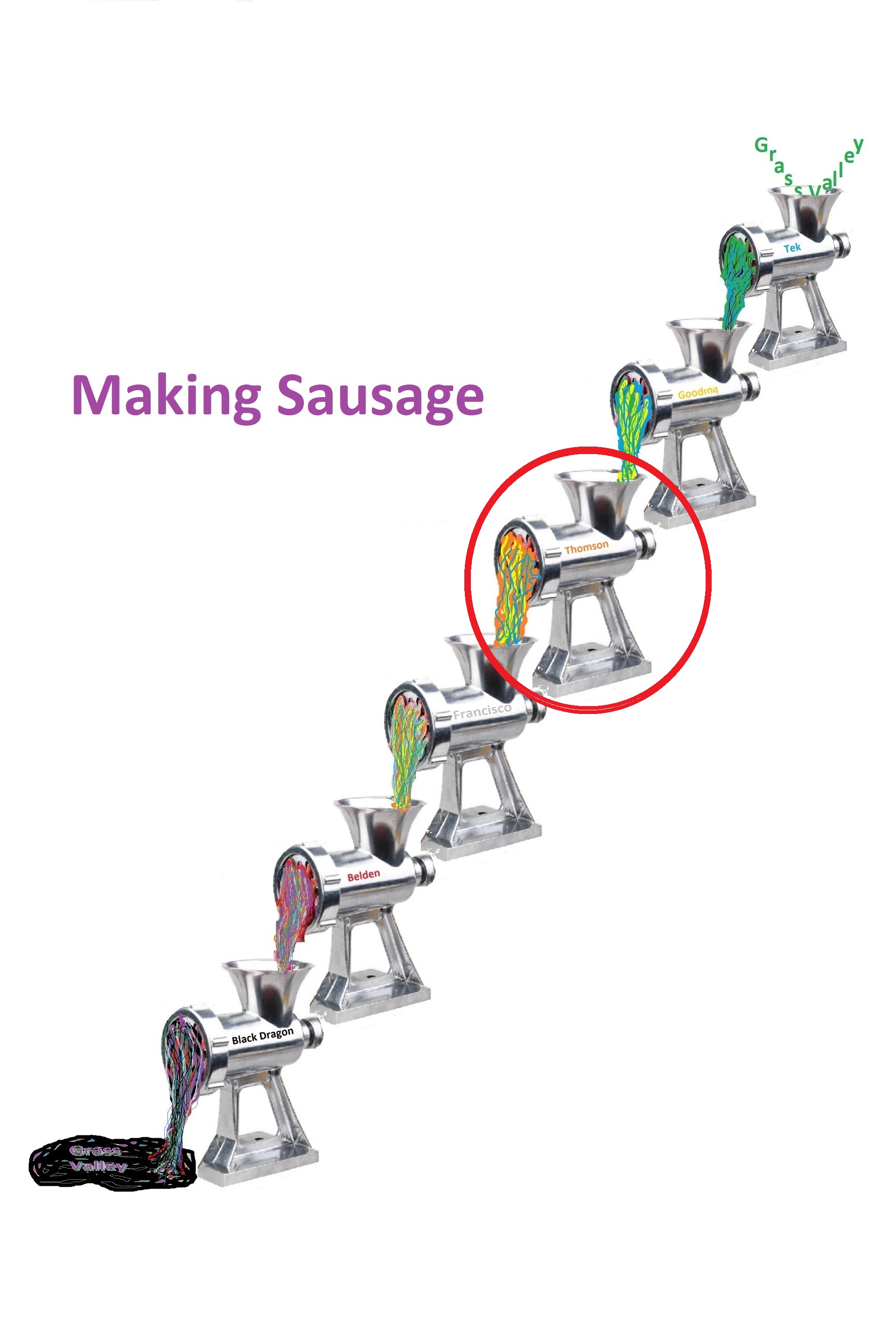
In April 2002, the French electronics giant Thomson Multimedia, today known as Technicolor SA, became the third owner of the Grass Valley Group.Combined, the two companies were a $500 million-a-year concern.p>
Officially it was renamed “Le Groupe de la Vallée de l'Herbe,” which is is a literal, word-for-word translation of “The Grass Valley Group”.
Le Groupe = The Group de la Vallée = of the Valley de l'Herbe = of the Grass
In reality, this phrase was used occasionally (mostly tongue-in-cheek or in very formal legal translations) during the Thomson era in French-speaking countries when someone wanted to avoid saying the English name “Grass Valley” while still making it clear which company was being referred to. You would mainly see it in France, Belgium, or Quebec goverment contracts. The phrase was considered a bit ridiculous even at the time.
This part of the Grass Valley legacy is so convoluted, calamitous, and complicated that the only way to preview it is in graphical form. It's a story of an entity intentionally becoming corpulent by its crapulous consumption of other companies. Enough of the adjectives that begin with c. So here is the "roadmap" of that story.
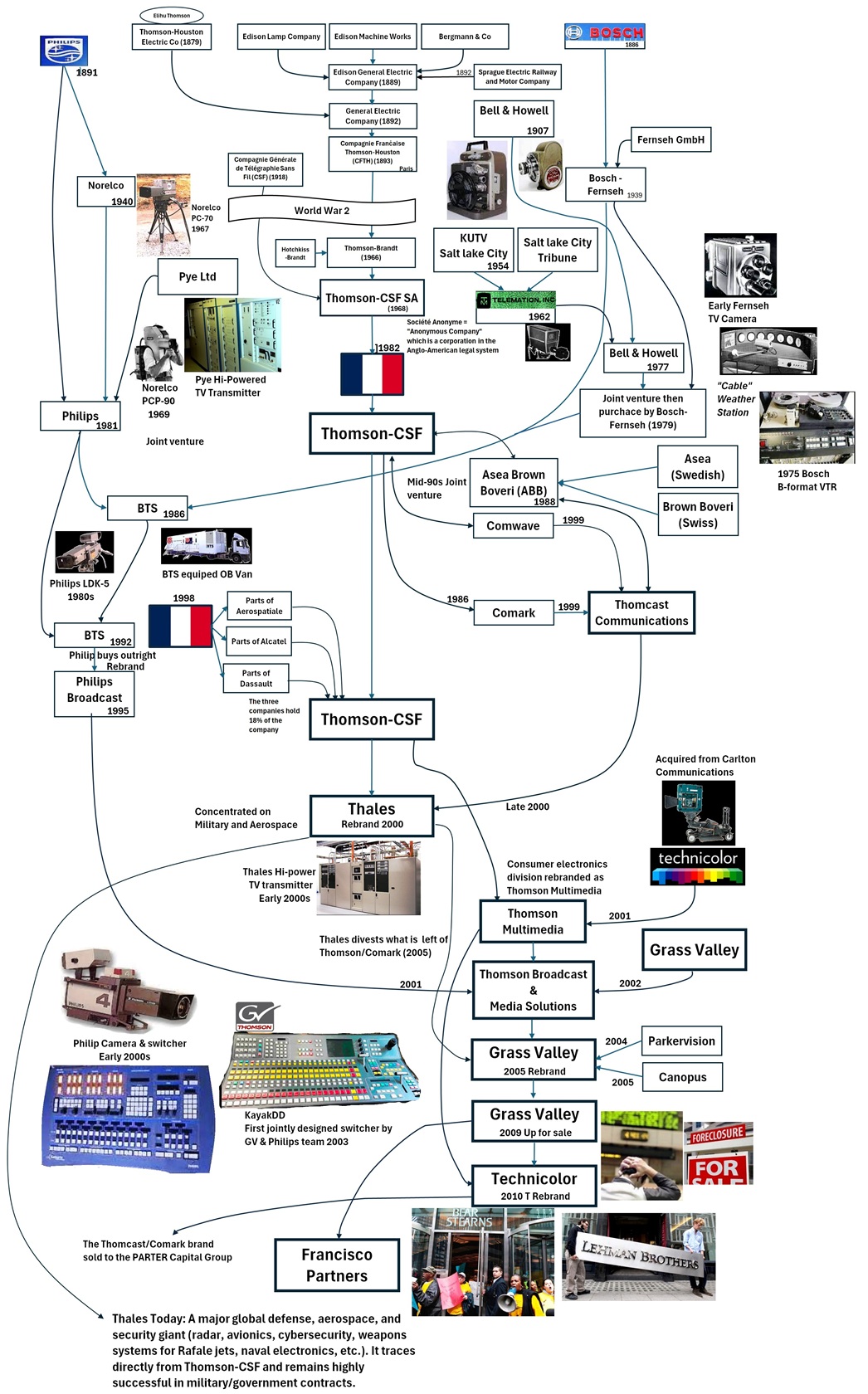
The very short synopsis of the story is: Thomson’s acquisition strategy was ambitious. There was a lot of buying. Then external forces overwhelmed its situation. It unraveled. What was left after it was over changed its name.
Thomson (originally Thomson-CSF, later Thomson Multimedia and then Technicolor) was a French electronics and defense conglomerate. In the 1990s and early 2000s, it aggressively acquired broadcast and media technology companies to build an end-to-end media infrastructure empire. This included:
Thomson's goal was to become the RCA of the 21st century, offering everything from set-top boxes and cameras to video servers and post-production systems. What stopped it? The financial crisis, which exposed weaknesses, ended up forcing a breakup because of the breaking of loan covenants. It takes lots of money to bulk up. Interest rates were extremely low, and banks were eager to lend to “convergent” French champions. Thomson issued high-yield bonds and drew massive revolving credit facilities.
So Thomson Multimedia used aggressive leveraged acquisitions in the early 2000s to transform itself from a fading French consumer electronics maker into what it hoped to be the world’s dominant broadcast and media-technology conglomerate. The next RCA.
Every acquisition was immediately loaded with new debt secured against the cash flow of the acquired company. As long as each acquisition continued to pay its freight, all was good. This allowed Thomson to pay cash for each deal without diluting shareholders.
Thomson management told investors and banks that combining Grass Valley, Philips Broadcast, and Technicolor services would produce hundreds of millions in cost savings and cross-selling. Thus justifying ever-higher debt multiples.
Their plan for dominence:
As you can see on the road map above, the plan included many more deals. Exploring the Thomson Lineage.
If you look at the chart above, you can see that Thomson and Thales had an interesting relationship. Thomson-CSF's defense branch became Thales. Meanwhile, Thomson Multimedia, focused on consumer and media, eventually turned into Technicolor when all was said and done. There was no absorption of Thales into Thomson Multimedia. One crossover was the Comark transmitter business, which later went to Thomson Multimedia.
Thales Today is still a major global defense, aerospace, and security giant (radar, avionics, cybersecurity, weapons systems for Rafale jets, naval electronics, etc.). It traces directly from Thomson-CSF and remains highly successful in military/government contracts.
Comark was the other broadcasting piece that survived the Thomson experience. It remained outside the Grass Valley gravitational field. A private equity firm revived it. In 2014, it became part of Hitachi Kokusai Electric Comark LLC. People often call it Hitachi-Comark or simply COMARK.
Thomson used cheap, covenant-heavy bank and bond debt to lever up and buy adjoining media technology companies. It was a classic 2000s roll-up. As we will see, this was not the last time this was tried.
Grass Valley entered a period of initial integration and expansion but ultimately faced severe headwinds due to Thomson's broader corporate instability. During this era, Grass Valley, renamed Thomson Grass Valley, struggled with economic downturns, internal restructurings, and divestiture pressures. While the merger was aimed at creating synergies in professional video equipment, it instead led to operational complexities, as Grass Valley's California-based engineering culture clashed with Thomson's more diversified, France-centric structure. Employees noted bureaucratic delays in R&D, slowing innovation in the shift to digital workflows.
Despite initial efforts to integrate everything under the Thomson umbrella (e.g., "Thomson Grass Valley"), the Grass Valley name emerged as the survivor for several key reasons tied to brand equity, market perception, and strategic decisions during divestitures and mergers. This branding included all Philips products. For media equipment buyers, Philips was no more. Thomson Grass Valley was now the company-wide brand. Grass Valley had strong recognition in the U.S. market; it was key for live production and sports, while Philips/Thomson lines were stronger in Europe. Unifying under Grass Valley leveraged its reputation for innovation in switchers. The fact that Grass Valley was slow to digital and HD showed up for the game at just the right time, and with something in its core market it hadn't had in a while: the right product at the right time, the Kalypso.
In 2005, when the whole Thomson endeavor became known as Grass Valley. Its brand recognition became large enough that future forced mergers never came with added brands larger than its own. So the Grass Valley brand was kept standing while newly added assets, some storied in their own right, all flew under its banner.
A strategic acquisition incurred in 2005, Thomson bolstered Grass Valley by acquiring Canopus Corporation, integrating its Edius nonlinear video-editing software. This expanded offerings into high-definition editing and encoding, targeting growing demand in news and post-production. However, the acquisition added integration costs and diluted focus, as Thomson juggled consumer electronics alongside professional broadcast tools.
By 2007, Thomson’s net debt (reported officially in euros) had reached €2.3 billion ($3.15B) against EBITDA of only ~€670 million ($919M), resulting in a leverage ratio of ≈ 3.4. This is considered a bit high for a cyclical media-tech business. And it was in a definitely cyclical business. But often that has nothing to do with the customer calendar year budgets. It is often events and mandates that equate to a super "Christmas" season.
Going by many media companies' calendar budgets, you'll find that media companies do not spend evenly throughout the year. 60–70 % of annual CapEx in the entire broadcast and production industry is spent in the last 4–5 months, with 40–55% literally in Q4. The last two weeks of December often are the single biggest purchasing period of the entire year. The company's CFO or other keeper of the purse strings often sends out the "spend it or we lose it" email around October.
But the big Christmas seasons don't happen in 12-month intervals. Some result from mandates by governments. Example: ATSC. Some are competitive. We looked at one in the last chapter with the ESPN HD mandate. Want to do business with the largest consumer of live remote television after 2009? Better call your Grass Valley, Sony, or Ikegami reps. Another is sports rights renewals. Your network just spent hundreds of millions of dollars on rights to the NFL, the Olympics, etc. Expectations are you better make it look like a hundreds of millions event on air. You better make sure you have the latest and greatest of everything! Not often, but it has been caused by a large capital piece of gear that reaches an age where many start failing in short order from a built-in, deliberately or not, end-of-life trigger. Often it's when a vendor decides it will no longer support a piece of gear.

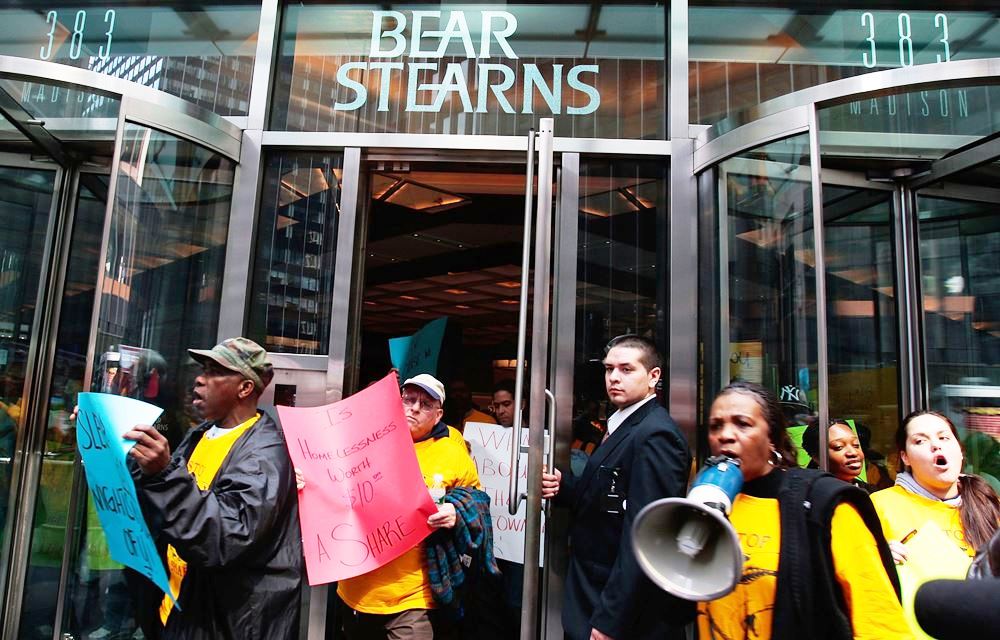
The 2008 financial crisis exposed weaknesses. Heavy debt and an overextended portfolio made Thomson vulnerable. The global financial crisis in 2008 hit the entire media and electronics markets hard. The actual Grass Valley part of the overall company, generated about $1.3 billion in annual sales (roughly 20% of Thomson's revenue), became a cash cow but was strained by Thomson's push for short-term profitability over long-term R&D.
The 2008–2009 recession hit the broadcast sector hard, delaying capital investments by TV networks and studios. Grass Valley saw order slowdowns for high-end gear like production switchers and servers, exacerbating revenue dips. This mirrored broader media industry contraction, with clients like ESPN and ABC deferring upgrades amid ad revenue slumps.

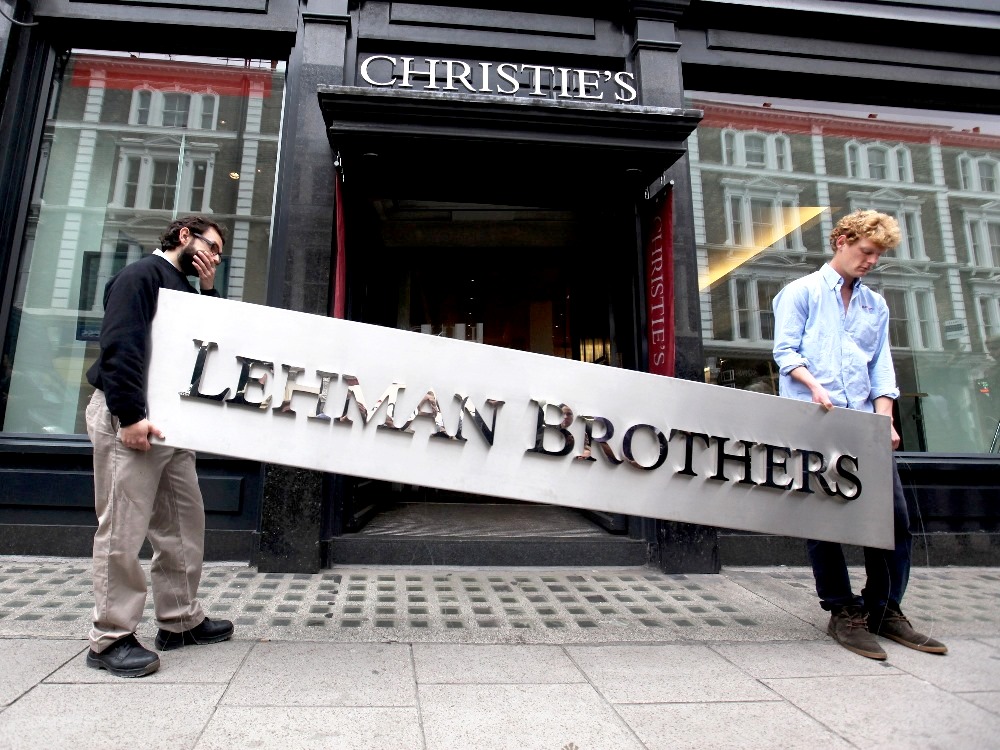
When the recession crushed cash flow, it not only lost the ability to service the debt; Thomson defaulted on financial covenants tied to its massive debt load, triggering creditor demands for asset sales to avoid bankruptcy. Grass Valley was deemed "non-core" as Thomson pivoted to services like film processing and content distribution. On January 29, 2009, Thomson announced the Grass Valley division (excluding head-end/transmission units) was up for sale to raise cash and refocus on stable revenue streams.
In October 2009, talks with U.S. private equity firm Platinum Equity collapsed over disagreements on restructuring financing needs. Grass Valley required significant capital for modernization (e.g., IP-based transitions), but Platinum balked at the estimated costs, leaving the unit in limbo and prolonging uncertainty. To cut costs, Thomson laid off about 21 employees at Grass Valley's Nevada County, California, facilities in December 2008, reducing local headcount to around 280. Globally, the company faced talent attrition as engineers jumped to competitors like Sony amid Thomson's instability.
Thomson's overall financial overhaul included French government assistance and advisors like Perella Weinberg Partners. Grass Valley's sale process dragged into 2010, with interim measures like spinning off its digital film transfer business (e.g., Spirit scanners) to PARTER Capital Group in late 2008 for an undisclosed sum. This fragmented operations and eroded employee confidence.
In early 2010, shareholders approved a debt overhaul, renaming the company Technicolor SA to emphasize its historic film-processing roots. In March 2010, as part of Technicolor's debt plan, 25% of Grass Valley's global workforce, about 625 jobs, were cut. This included roles in engineering and sales, further hampering product development during a critical shift to digital and IP technologies.
In September 2010, Thomson separated Grass Valley's transmission (renamed Thomson Broadcast) and head-end (Thomson Video Networks) units as standalone entities for separate divestitures. This carved up the company's ecosystem, disrupting integrated solutions for broadcasters and forcing customers to seek fragmented alternatives.
All this left Grass Valley in survival mode, with delayed innovations and a tarnished market position. Despite this, its core products remained industry staples, powering events like the Olympics.
Finally, the sale of what remained of Grass Valley to Francisco Partners in July 2010 was completed. This San Francisco-based private equity firm made a binding $100 million offer for the core broadcast unit. The deal was structured as €20 million in cash upfront plus an $80 million promissory note. The deal closed on January 1, 2011, allowing Grass Valley to operate autonomously with San Francisco offices. This infusion stabilized operations, enabling R&D in cloud and IP solutions.
What Went with the Sale: the core Grass Valley Broadcast &smp; Professional Business operations. This included:
In addition: all global R&D centers (Nevada County, CA; Montreal, Canada).
Factories and production facilities worldwide.
Worldwide sales teams and systems integration activities.
Customer support organization (including 24/7 helpdesks).
Management and administrative functions dedicated to the business.
Patents, trademarks, and technology related to the above (multi-format HD innovations from the Philips/Grass Valley merger).
1,457 staff in roles tied to broadcast/production (engineering, sales, support).
As it turned out, Thomson’s ownership failed to nurture or strategically evolve Grass Valley, turning it again into a corporate hot potato and stalling its innovation just when the industry was starting to shift toward software and IP-based video.
The impact on Philips Broadcast, another big component of the temporary alliance, was assimilation, then brand obsolescence. Most of the Philips-branded technology was sunsetted or absorbed into Grass Valley's product lines. Philips Broadcast had once been a major force in Europe and Asia, known for cameras, switchers, and transmission gear.
Final Thoughts: The Thomson saga demonstrates over-acquisition without proper integration. Grass Valley and Philips both brought tremendous engineering assets and market credibility, but Thomson lacked the cohesion and long-term vision to align them into a competitive, modern broadcast technology company without amassing tremendous amounts of debt. Grass Valley's core sold for far less than the hundreds of millions Thomson had borrowed against it.
But as we will see, this was not the last try at achieving RCA 2.0 based on the Grass Valley brand.
What's this about RCA?
